HAL’s AMCA Stealth Fighter India’s Feature-Packed Aircraft


site

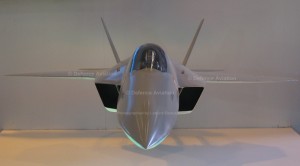
In Aero India 2013, India has publicized an updated design for its 5th generation fighter concept AMCA (Advanced Medium Combat Aircraft). Formerly this aircraft was known as the MCA (Medium Combat Aircraft). It is a single seat twin engine 5th generation stealth multirole fighter that is being developed by India. This fighter is supposed to complement the eminent fighters like the Sukhoi/HAL FGFA, HAL Tejas, the Dassault Rafael and the Sukhoi Su-30MKI. Unofficial blueprint related work on this aircraft has been started. In fact a marine version is also confirmed as the Indian Navy contributed to its funding too. In Aero India 2013 the ADA revealed a 1:8 scale model.
This aircraft is being designed as a reasonable fighter together with swing role facility in order to meet the necessities of the IAF post 2020. It will have technologies like super cruise, super maneuverability, advanced sensor suit with fusion and stealth as its features.
Design of AMCA:
The design of the AMCA includes a very small radar cross-section & will also have serpentine   like air intakes, internal arsenal as well as the state-of-the-art radomes in order to enhance its stealth feature. The design will also be supplemented through radar-absorbing composites as well as paints.
AMCA will be a twin-engine design. It features the GTX Kaveri engine with thrust vectoring. There is possibility that it will give the aircraft the capabilities of supercruise. The design based stealth characteristics of the aircraft will include additional optimized edge matching, airframe shaping, body confirming antennae & a low IR signature all the way through nozzle design, engine bay cooling as well as work on decreased exhaust temperature. With advanced sensors the aircraft will be loaded with missiles like DRDO Astra along with some other superior missiles, standoff weaponry as well as precision weapons. The aircraft will feature the ability to deploy Precision Guided Munitions. It will also feature extensive detection range as well as targeting range with the capacity to release arsenals t supersonic speed. The avionics suite of the aircraft will consist of AESA radar, IRST along with suitable electronic warfare systems as well as all feature missile-warning-suite.


SOURCE : http://www.defenceaviation.com/

Comments

Popular posts from this blog

LCA-Tejas : Cleared for Export, DRDO and IAF to Work together in exploring possibilities

After been Cleared for Export by Ministry of Defence with firm backing of Indian air force which too has given its blessing, DRDO is working on exploring possibilities to hard sell its indigenous Light Combat Aircraft (LCA) Tejas to prospective buyers from overseas in 2016 on wards. Sources close to the programme told idrw.org that after formal list of defence items which can be exported has been endorsed by the ministry of defence, which also included LCA-Tejas, DRDO and IAF are working on plans to work together in exploring potential buyers for the aircraft. DRDO believes that long-delayed LCA-Tejas project which is finally inching towards its final FOC Certification and at the price point of around 30 $ million equipped with Modern Radar, digital fly-by-wire system, flight control systems and open architecture computer, LCA-Tejas can be easily termed among best aircraft currently in its type. Earlier in Aero India 20015  held in India many Prospective buyers...

Boeing’s F-18 Super Hornets ‘Super Confident’ Of Beating French Rafale Jets To Grab Indian Navy’s Fighter Jet Deal

Rafale-M F-18 Super Hornets US aerospace giant Boeing seems confident about F-18 Super Hornets winning the Indian Navy’s carrier-borne fighter jet contract, outpacing the French Dassault Rafale fighter jets, according to the latest reports. In January 2017, the Indian Navy issued an RFI (Request for Interest) to acquire 57 multi-role carrier-borne fighters, after long delays and technical glitches in building the indigenous HAL-Tejas for the Navy. Among the four contenders in the race, the Boeing F/A-18 Super Hornet and Dassault Rafale navy-variant are head-to-head in winning the ₹24,000 crore deal, given the Indian Navy’s twin-engine preference. The other two are Sweden’s SAAB and Rosoboronexport of Russia. Both Dassault and Boeing are marketing their fighters as suitable for the Indian Navy, claiming their respective aircraft can be easily integrated with India’s first Indigenous Aircraft Carrier (IAC-1), named Vikrant, set to be commissioned in 2022-23.         ...

Fifth test of China's WU-14 hypersonic glide vehicle conducted

China successfully carried out the fifth test of its WU-14 hypersonic glide vehicle from the Wuzhai missile test range in northern China’s Shanxi province on Aug. 19, reports the Washington Free Beacon. Pentagon officials said the WU-14 — as it has been designated by the Pentagon — not only traveled along the edge of the atmosphere but also demonstrated evasive maneuvers during the latest test, the report said. This information indicates that the hypersonic glide vehicle was designed particularly for a potential war with the United States, the report said. US missile defense systems are developed to intercept missiles that follow predictable flight paths. They are unable to counter maneuvering warheads and glide vehicles, said the report. A defense official said the WU-14 is viewed as a serious emerging strategic threat that could complicate US nuclear deterrent efforts. Richard Fisher of the International Assessment and Strategy Center said that the best defensive response ...