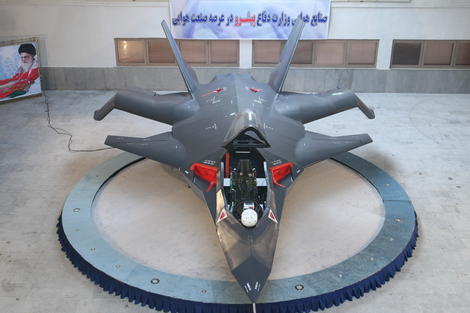
On February 1, 2013, Mahmoud Ahmadinejad and the defense minister Ahmad Vahidi along with other government and defense officials revealed a new aircraft called the Qaher (Conqueror) F-313 to the world. Along with the revealing of a new fighter, videos of the F-313 R/C model was shown flying along wind tunnel testing and other technical details were shown about the aircraft. However, in the last few years, there have been talks coming from Iran that they were developing a next-generation stealth fighter to replace their older fighters like the F-4D/E Phantom II and F-5E/F Tiger II from the Shah era and also to compete against U.S and Israeli fighters like the F-15, F-16, and the F/A-18 multirole fighters.
On to the design, the F-313 looks too be more based off the McDonnell Douglas X-36 UAV, McDonnell Douglas original X-32 concept for the JSF program in the mid-1990’s. Nevertheless, the mockup felt like it was rushed out most likely due political reasons with a lot of things missing like the cockpit for example is missing a lot electronics and avionics like the heads up display (HUD). But according to the Iranian officials, the Qaher will feature a lot of “advanced radar adsorbent materials” and consider the aircraft easier to maintain. Wing design looks like it was based of the X-36 experimental UAV with exception of the downward winglets along with featuring canards and a V-shaped tail design. Its weapons capability will included a number of foreign or indigenous made AAMs, AGMs, PGMs, bombs, rockets, and possibly AShMs in which six will be carried in its weapons bay or on its wings. No word was mention about the cannon, but more likely it will be feature either a 20mm or 30mm gun. Despite the missing avionics and electronics, the Qaher will be fitted with radar, HUD, and other equipment and systems.
While the F-313 will be powered by one engine, but nonetheless, there are no word which engine they will be using though for the aircraft. From some reports I have readied so far, that the engines can be either the Pratt & Whitney TF-30 that powers the Iranian’s F-14 Tomcats or the RD-33 that also powers their MiG-29 Fulcrums. Also, additional reports points that the Qaher will also have thrust vectoring capability to, but I’m skeptical about the intake design though because of its small size. So far, what we know is that the F-313 is 16 meters at length with a maximum takeoff weight at 20,000kg. The aircraft landing will be similar to the Su-25 Frogfoot which the IRIAF and IRGC forces. Qaher will also be using fly-by wire (FBW) technology which is not surprising considered aircraft design. Even though the aircraft is capable of supersonic speeds according to defense officials, but no word on what speed it’s capable of or range and height. A couple other reports also reported that the Qaher is also based off the HESA Shafaq multirole strike aircraft which was revealed back in 2007, and even though the Iranian military said the type is under development, no word has been said about the aircraft since.
Even despite the revealing of the Qaher F-313 a couple of days ago, but very little is known about the aircraft and that is how much is believable since the Iranian government and military has an history of Photoshopping and videoshopping some of their military equipment for the last few years. A lot of debate among people on various military forums and defense sites if the Qader is either an actual stealth fighter or a research aircraft system to U.S X-Planes research aircraft. However, my personal issue with this revealing it’s more political than anything because with the ongoing debate with Iranian nuclear program, Syrian Civil War, and the latest airstrikes on a convoy and buildings in the Syrian border a few days ago by the Israeli Air Force made the Iranians decided to revealed the aircraft as political stunt. But the big question remains, will the Qaher F-313 ever fly or is it just a big political stunt to draw away international attention from their nuclear program and other hot issues that is going on in Iran.
What do you think about Iran’s achievement? Let us know in the comment section


Comments
Post a Comment